
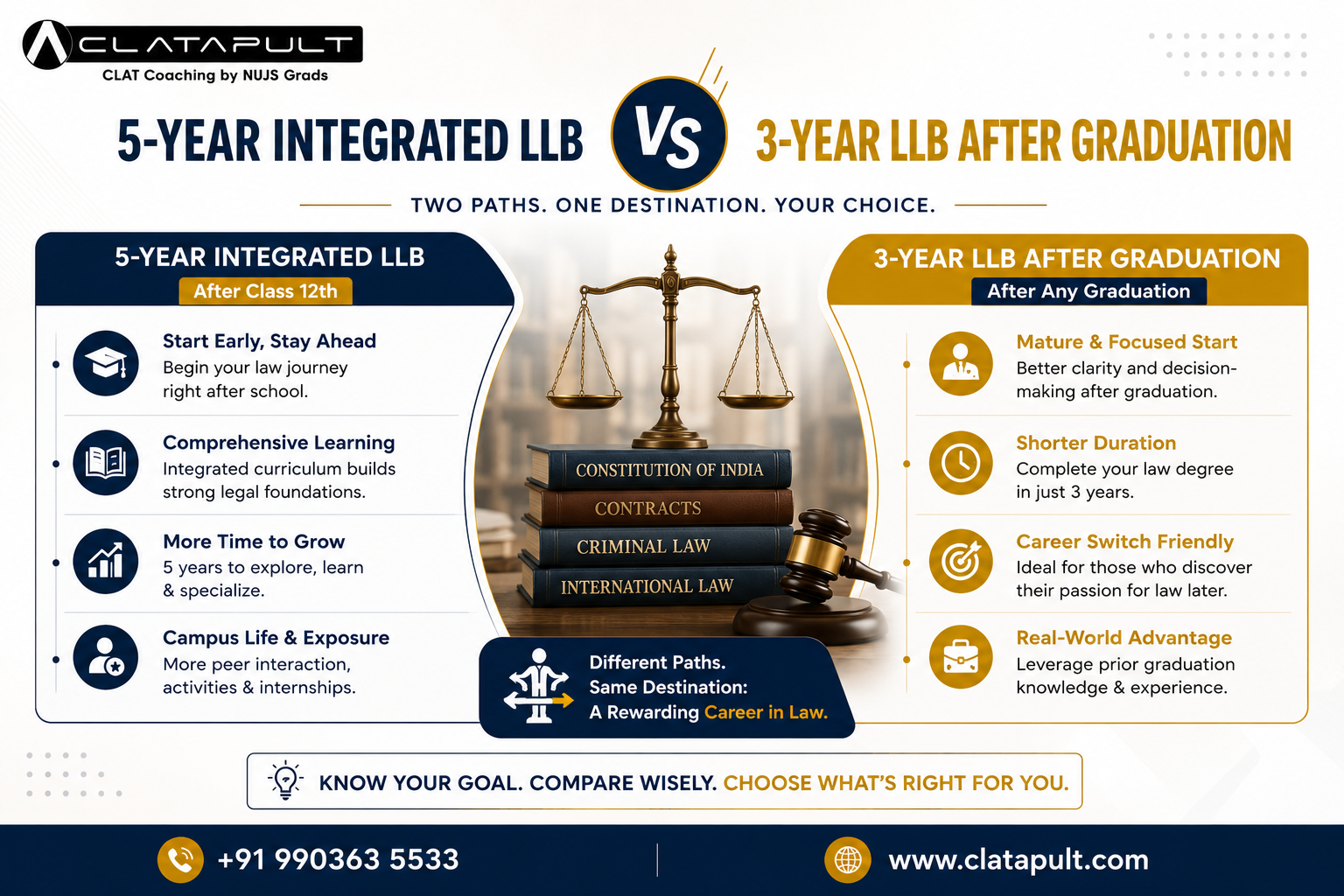
5-Year Integrated LLB vs 3-Year LLB After Graduation
If you are trying to figure out how to become a lawyer in India, you have probably run into two very different routes: the 5-year integrated LLB and the 3-year LLB after graduation. Both lead to the same degree at the end (a Bachelor of Laws), and both let you practice as an advocate once you clear the Bar Council exams. But the journey, the entrance exams, the age at which you start, and even the kind of career you end up building can look quite different depending on which path you choose.
This guide breaks down everything a law aspirant needs to know: what each programme actually involves, which entrance exams open the door to each one, how the career outcomes compare, and how to decide which path fits your specific situation. Whether you are a Class 12 student trying to decide right now, or a graduate wondering if it’s too late to switch to law, this comparison should give you clarity.
What Is a 5-Year Integrated LLB Programme?
The 5-year integrated LLB is the route most CLAT aspirants are already familiar with. It combines an undergraduate degree (BA, BBA, BSc, or BCom) with a Bachelor of Laws degree into a single, continuous five-year programme. Students join right after Class 12, without needing a prior graduation degree.
This is the format offered by nearly all National Law Universities (NLUs), including NLSIU Bangalore, NALSAR Hyderabad, NUJS Kolkata, NLU Delhi, and the other institutions under the CLAT Consortium. It is also offered by several private law schools such as Jindal Global Law School and Symbiosis Law School.
Key features of the 5-year integrated LLB:
- Eligibility is based on Class 12 marks (usually 45 percent to 50 percent, depending on the institution and category)
- Admission happens through entrance exams taken right after school
- Students graduate with a dual degree, for example BA LLB (Hons.) or BBA LLB (Hons.)
- The programme includes ten semesters, giving students significantly more time for internships, moot courts, and specialisation electives
- Most students who choose this path are between 17 and 18 years old when they start
Because the programme runs five years, students get far more exposure to internships, client counselling simulations, and research work during their law school years compared to a compressed three-year format.
What Is a 3-Year LLB After Graduation?
The 3-year LLB is designed for candidates who have already completed an undergraduate degree in any stream, whether that’s BA, BCom, BSc, BTech, or any other discipline. Instead of starting law school right after Class 12, students first finish a full graduation degree and then pursue law as a second, focused degree.
This path is popular among:
- Working professionals who want to formally transition into law
- Graduates who discover an interest in law only after finishing their first degree
- Candidates with a specialised undergraduate background who want to pair it with law, such as a BCom graduate targeting corporate and taxation law, or a BSc graduate aiming for intellectual property law
- Civil servants, chartered accountants, and other professionals who want a law degree to expand their practice areas
Key features of the 3-year LLB:
- Eligibility requires a completed bachelor’s degree, typically with 45 to 50 percent aggregate marks
- There is generally no upper age limit, which makes this route accessible at almost any stage of life
- The programme is condensed into six semesters instead of ten
- Students often bring subject-matter expertise from their first degree into their legal specialisation
Delhi University’s Faculty of Law, through its Campus Law Centre, Law Centre-I, and Law Centre-II, is one of the most well-known destinations for the 3-year LLB, along with several state university law faculties and private institutions.
Key Differences Between 5-Year Integrated LLB and 3-Year LLB
Here’s a side-by-side look at how the two paths compare on the factors that matter most to aspirants and parents.
Starting point
5-year integrated LLB: right after Class 12
3-year LLB: after completing any undergraduate degree
Total years to become a lawyer
5-year integrated LLB: 5 years
3-year LLB: 3 years (plus the 3 to 4 years already spent on graduation, so effectively 6 to 7 years from Class 12)
Degree awarded
5-year integrated LLB: Dual degree, for example BA LLB, BBA LLB, BSc LLB
3-year LLB: Single degree, LLB
Typical entrance exams
5-year integrated LLB: CLAT, AILET, NLSAT (for NLSIU’s 5-year programme), state-level law entrance exams
3-year LLB: CUET PG LLB, MH CET Law, NLSAT-LLB, and various university-specific exams
Ideal candidate
5-year integrated LLB: Class 12 students who already know they want to pursue law as a first career
3-year LLB: Graduates, working professionals, or those who decided on law later
Internship and moot court exposure
5-year integrated LLB: Generally higher, since the five-year format allows more semesters for co-curricular and practical exposure
3-year LLB: More compressed, though many students bring in professional experience from before law school
Depth of specialisation options
5-year integrated LLB: Broader, with more room for electives across ten semesters
3-year LLB: Narrower timeline, though students often specialise faster since they already know their interest area
Both degrees are recognised equally by the Bar Council of India, and graduates of either path must clear the All India Bar Examination (AIBE) before they can practice law independently. Neither degree is inherently “better” on paper. What differs is the journey to get there and the kind of student each path suits.
Entrance Exams You Need for Each Path
Entrance Exams for the 5-Year Integrated LLB
If you are targeting the 5-year integrated LLB straight after Class 12, the exams you need to prepare for include:
- CLAT (Common Law Admission Test): the gateway to 24-plus NLUs across the country, including NLSIU, NALSAR, NUJS, and NLU Delhi’s counterparts
- AILET: conducted independently by NLU Delhi
- NLSAT: NLSIU Bangalore’s own admission test for its 5-year programme
- Private law school entrance tests: such as SET for Symbiosis Law School and LSAT India for Jindal Global Law School
Since CLAT remains the single largest gateway into India’s top law schools, most aspirants build their entire Class 11 and Class 12 preparation timeline around it. This is exactly the kind of preparation CLATapult specialises in. If you are a Class 11 or 12 student deciding to pursue the 5-year integrated LLB route, CLATapult’s structured CLAT coaching, built and taught by NUJS Kolkata graduates, can help you prepare for CLAT with dedicated mock tests, current affairs support, and mentorship from students who have been through the exact same exam.
Entrance Exams for the 3-Year LLB
If you have already graduated or are in your final year of graduation, the exams that lead to the 3-year LLB include:
- CUET PG LLB: conducted by the National Testing Agency, and now the primary gateway for Delhi University’s 3-year LLB programme along with several other central and state universities
- MH CET Law: for law colleges in Maharashtra, including Government Law College, Mumbai
- NLSAT-LLB: NLSIU Bangalore’s separate test for its 3-year LLB track
- State-level and university-specific entrance exams: many state universities and private colleges run their own tests for graduate entrants
Eligibility for these exams almost always requires a completed bachelor’s degree with a minimum aggregate percentage, and final-year graduation students are usually allowed to apply provisionally, pending their final results.
Career Outcomes: How the Two Paths Compare in the Job Market
This is often the deciding factor for aspirants weighing both options.
Litigation and judiciary
For a career centered on litigation or judicial services, the path you take matters far less than the quality of your practical training and your performance in judiciary exams later. Both 5-year and 3-year LLB graduates appear for state judicial services exams on equal footing.
Corporate law firms
Top-tier corporate law firms overwhelmingly recruit from NLUs through campus placements, and the vast majority of NLU students come through the 5-year integrated route via CLAT or AILET. This does not mean 3-year LLB graduates cannot enter corporate law, but the campus recruitment pipeline is heavily weighted toward NLU graduates.
In-house counsel and specialised roles
This is where the 3-year LLB path can actually offer an advantage. A graduate with a BCom degree who later pursues a 3-year LLB often has a natural edge in taxation law, securities law, or corporate compliance roles, since they bring subject knowledge from their first degree. Similarly, a BTech graduate pursuing law later can carve out a strong niche in intellectual property or technology law.
Age and career timing
Students who take the 5-year integrated route typically become practicing advocates by the age of 22 to 23, giving them a longer runway to build seniority in their careers. Students who take the 3-year route usually qualify around age 24 to 26, depending on how long their first degree took, but they bring additional maturity and, in many cases, professional experience into the legal field.
Cost Comparison: 5-Year Integrated LLB vs 3-Year LLB
Cost is a genuine factor for many families. NLU fees for the full five-year programme typically range from 10 to 14 lakh rupees, while private law schools offering the same duration can charge significantly more. The 3-year LLB, by comparison, is often more affordable per programme since it is shorter, though you also need to account for the cost of the undergraduate degree completed beforehand. When you add up the total years of education from Class 12 to a law degree, the two paths can end up costing a similar amount overall, just spread differently across your timeline.
Which Path Should You Choose? A Decision Framework
You should lean toward the 5-year integrated LLB if:
You are currently in Class 11 or 12 and are already certain that law is the career you want to pursue. You want maximum exposure to internships, moot courts, and campus placements at NLUs. You want to become a licensed advocate by your early twenties and start building seniority sooner.
You should lean toward the 3-year LLB if:
You have already completed, or are close to completing, a different undergraduate degree and want to add law as a second qualification. You are a working professional (such as a chartered accountant, engineer, or civil servant) looking to formally add legal expertise to your career. You discovered your interest in law only after starting a different academic or career path, and you want to bring that domain knowledge into a legal specialisation.
Neither path is objectively superior. The right choice depends on where you are in your academic journey right now and what kind of legal career you are aiming for.
Start Preparing the Right Way, Whichever Path You Choose
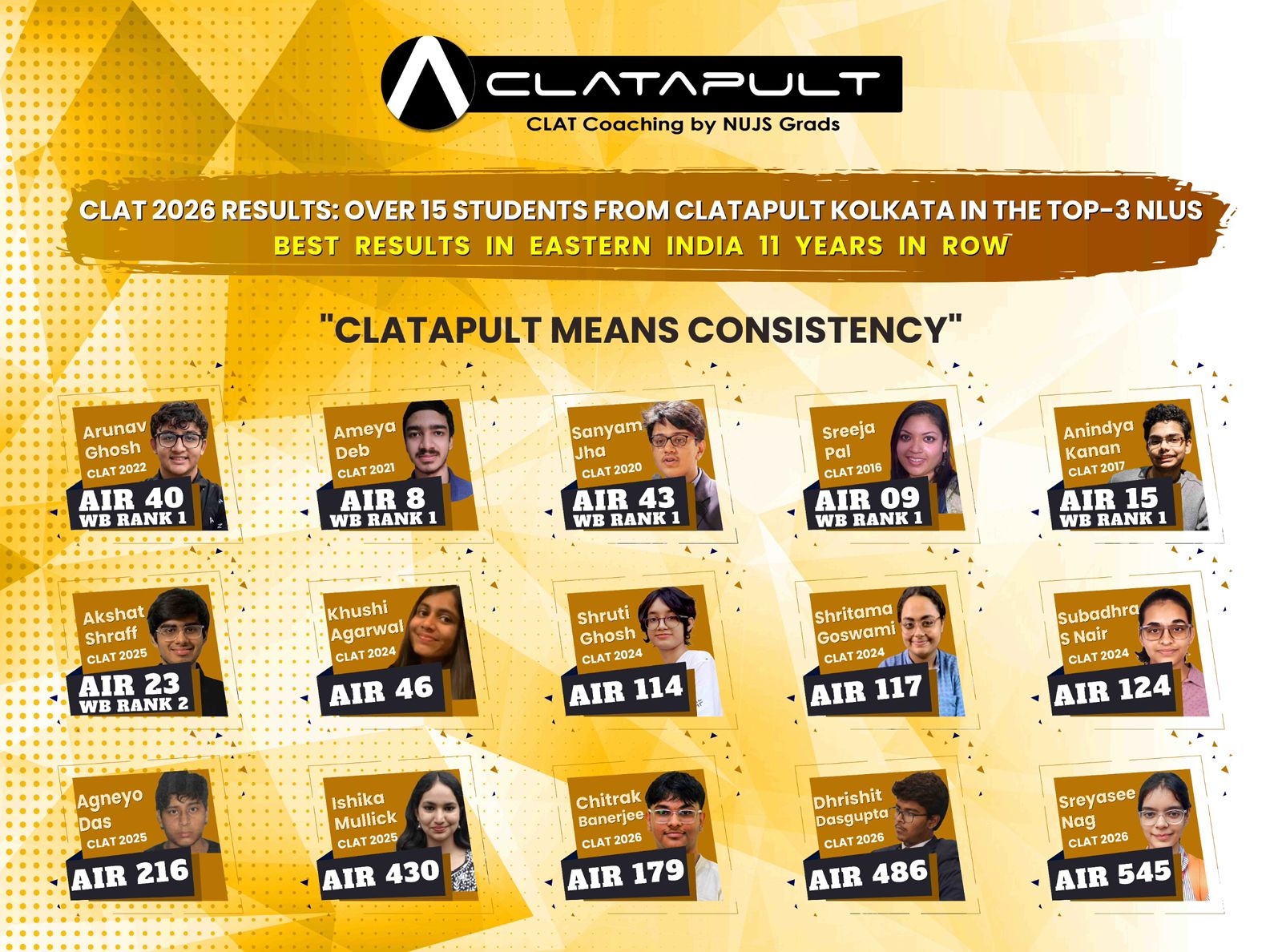
If you are a Class 11 or 12 student who has decided the 5-year integrated LLB is your path, the smartest next step is to start your CLAT preparation early and with the right guidance. CLATapult has been Eastern India’s number one ranked CLAT coaching institute for over eleven years, with a track record of All India Ranks and a faculty made up entirely of NUJS Kolkata law students who have cracked the exam themselves. From structured study material and hundreds of mock tests to monthly current affairs magazines and doubt-clearing sessions, CLATapult is built specifically for students targeting NLUs through the 5-year integrated route.
If you are a graduate weighing whether to pursue law through the 3-year LLB route, understanding the CLAT ecosystem still matters, since many students explore both CLAT PG and CUET PG LLB routes depending on their long-term goals. Reach out to CLATapult’s team for personalised guidance on which entrance exam and preparation timeline suits your situation best.
Whichever path you are leaning toward, book a free demo class with CLATapult today and get a clearer sense of what focused, expert-led law entrance preparation actually looks like.
Frequently Asked Questions on 5-Year Integrated LLB vs 3-Year LLB
Is a 5-year integrated LLB better than a 3-year LLB after graduation?
Neither degree is inherently better. Both are recognised equally by the Bar Council of India. The 5-year integrated LLB suits Class 12 students who are already certain about a legal career, while the 3-year LLB after graduation suits students who decide on law later or want to combine it with an existing undergraduate specialisation.
Can I do a 3-year LLB after any graduation degree?
Yes. The 3-year LLB after graduation is open to candidates from any undergraduate stream, including BA, BCom, BSc, and BTech, as long as they meet the minimum aggregate percentage required by the specific entrance exam and institution.
Which entrance exam is needed for the 3-year LLB in India?
The most common entrance exams for the 3-year LLB after graduation include CUET PG LLB (used by Delhi University and several other universities), MH CET Law, and NLSAT-LLB for NLSIU Bangalore’s graduate programme. Eligibility and exam patterns vary by institution.
Do NLUs offer the 3-year LLB, or only the 5-year integrated LLB?
Most National Law Universities primarily offer the 5-year integrated LLB through CLAT and AILET. However, a small number of institutions, including NLSIU Bangalore, also offer a 3-year LLB track for graduates through a separate entrance test.
Is CLAT required for the 5-year integrated LLB?
CLAT is the primary and most widely accepted entrance exam for the 5-year integrated LLB at NLUs across India. Some universities also accept AILET or their own entrance tests, but CLAT remains the exam that opens the door to the largest number of NLUs in a single attempt.
Which path leads to better placements, 5-year integrated LLB or 3-year LLB?
Campus placements at top corporate law firms are weighted heavily toward NLU graduates from the 5-year integrated route, simply because most large firms recruit directly from NLU campuses. That said, 3-year LLB graduates with a strong undergraduate specialisation often build equally successful careers, particularly in niche areas like taxation, IP, or in-house counsel roles.
How old will I be when I finish a 5-year integrated LLB versus a 3-year LLB?
Students who complete the 5-year integrated LLB typically qualify as advocates by age 22 to 23. Students who complete the 3-year LLB after graduation usually qualify around age 24 to 26, depending on how long their first undergraduate degree took.