
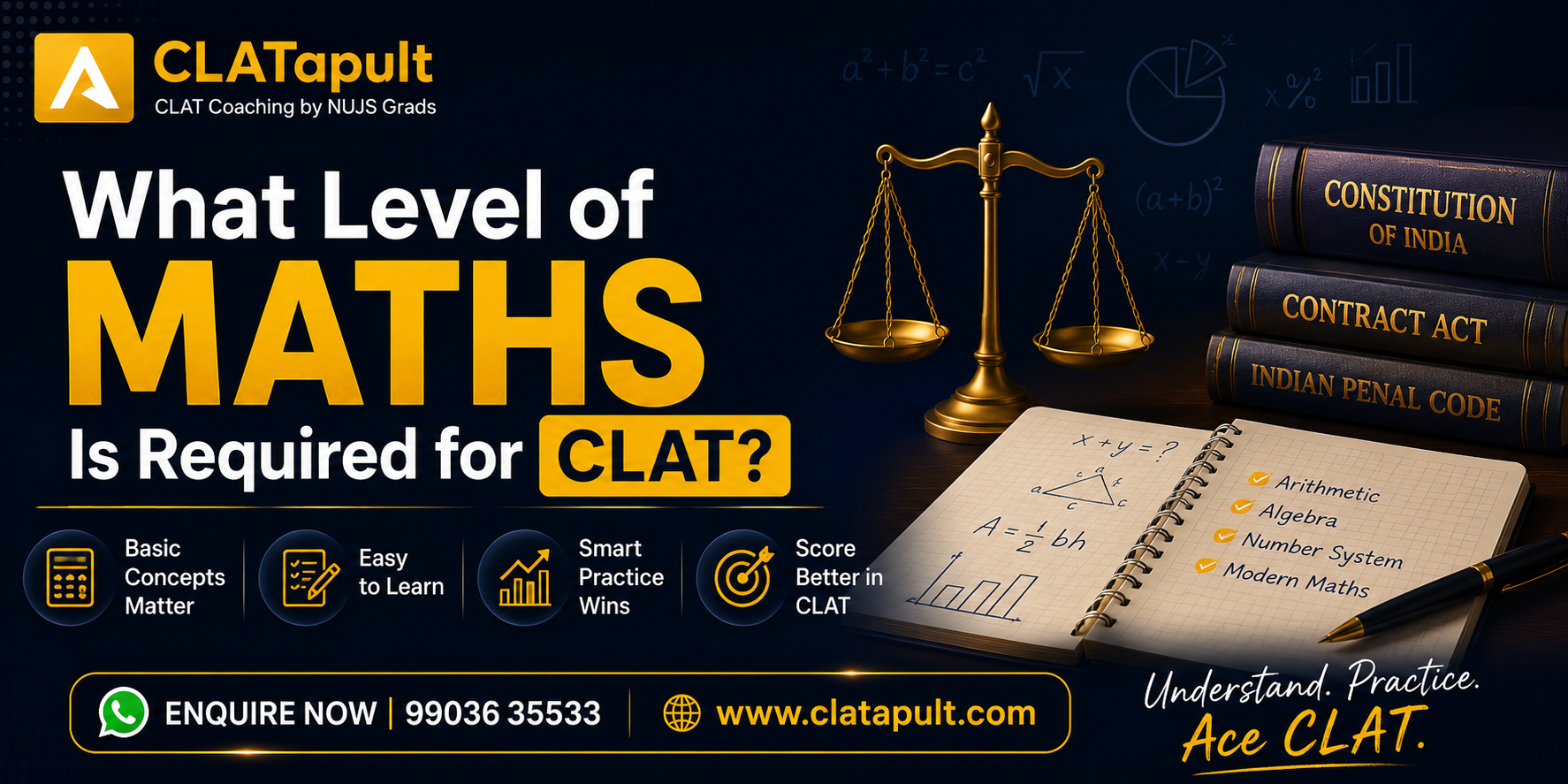
What Level of Maths Is Required for CLAT?
“I am from the arts stream. Will maths ruin my CLAT score?”
This is the single most common fear we hear at CLATapult from humanities and commerce students. The short answer is: what level of maths is required for CLAT is far lower than you think, and with the right approach, this section can actually become one of your easiest scoring areas on exam day.
Let us break it down completely so you can stop worrying and start preparing strategically.
What Level of Maths Is Required for CLAT? The Official Answer
The Quantitative Techniques section of CLAT is governed by a straightforward syllabus defined by the Consortium of NLUs. According to the official pattern, CLAT maths tests basic mathematical operations at the 10th standard level, including ratios and proportions, basic algebra, mensuration, and statistical estimation.
That is it. No trigonometry. No calculus. No matrices. No coordinate geometry beyond the basics. If you passed your Class 10 board examination in any stream, arts, commerce, or science, you already have the mathematical foundation CLAT requires. The problem is not the difficulty of the maths. The problem is that most arts students have not touched maths since Class 10, so the concepts feel unfamiliar.
The solution is not to study harder. It is to study the right things.
How Many Maths Questions Appear in CLAT?
Here is something that immediately puts arts students at ease.
The Quantitative Techniques section contains only 10 to 14 questions out of a total of 120. That is roughly 10 percent of the paper.
More importantly, these questions are passage-based, not formula-based. You will be given a short paragraph, a table, a graph, or a chart with numerical data, and then asked to answer questions using that information. CLAT maths is fundamentally a data interpretation exercise, not a computation exercise.
CLAT 2026 analysis showed this section was rated Easy to Moderate, and many students who focused on it strategically achieved near-perfect scores.
Exact Topics You Need to Cover for CLAT Quantitative Techniques
This is the precise list of what CLAT maths for arts students actually covers. Tick off what you already know and focus only on the gaps.
Core Arithmetic Topics
Percentages The single most important topic. CLAT passages almost always include percentage calculations, percentage change, percentage of a total, and comparing percentage growth across two periods. Master this above everything else.
Ratios and Proportions Simple ratio comparisons, proportion-based calculations, and part-whole relationships. These appear constantly in data interpretation passages.
Profit and Loss Basic profit and loss percentages, cost price versus selling price. Appears in economy-themed passages.
Averages Finding simple averages, weighted averages, and understanding what a change in average implies. Often embedded in data-heavy passages.
Time and Work / Time, Speed and Distance These appear occasionally but at a very elementary level, roughly Class 7 to 8 difficulty.
Data Interpretation (Most Critical for CLAT)
- Bar Graphs: comparing values across categories
- Pie Charts: calculating percentage share of a whole
- Line Graphs: reading trends over time
- Tables: extracting and comparing multiple data points
Data interpretation is where most of the 10 to 14 questions actually come from. An arts student who gets comfortable reading and interpreting graphs and tables can score 10 out of 14 or better without needing any advanced mathematical knowledge.
Basic Algebra and Mensuration
Simple linear equations at Class 8 level, and finding area and perimeter of common shapes. These appear very rarely and at minimal complexity.
What You Do NOT Need for CLAT Maths
Let us be explicit about what arts students can safely ignore:
- Trigonometry
- Calculus
- Quadratic equations
- Complex number theory
- Matrices and determinants
- Advanced coordinate geometry
- Probability and permutations at an advanced level
If any coaching institute or resource is teaching you these topics for CLAT, you are wasting your time.
A 4-Week Strategy to Master CLAT Maths for Arts Students
Arts students do not need months of maths preparation. Four focused weeks is enough if you follow this plan.
Week 1: Percentages and Ratios
Revise percentage formulae and practice 20 to 30 questions daily. Solve ratio and proportion problems from Class 8 to 10 NCERT. Target 90 percent-plus accuracy on percentage-based questions.
Week 2: Averages, Profit and Loss, Basic Word Problems
Cover averages, profit and loss, and simple time-speed-distance problems. Focus on understanding the logic of each problem, not just the formula. Practice with CLAT mock test questions from these topics.
Week 3: Data Interpretation
Spend this entire week reading and extracting data from bar charts, pie charts, line graphs, and tables. Time yourself: CLAT gives roughly 1 minute per question, so practice reading a passage and answering 3 to 4 DI questions in under 5 minutes. Use CLATapult’s sectional tests for authentic CLAT-style DI practice.
Week 4: Mixed Practice and Mock Integration
Solve the Quantitative Techniques section in full CLAT mocks. Identify the question types you are consistently getting wrong and revisit those topics. Aim to attempt all 10 to 14 questions. This section should be your fastest section on exam day.
The Right Mindset: CLAT Maths Is a Reading Test
Here is the insight that changes everything for arts students: what level of maths is required for CLAT is essentially the level of numeracy required to read a data report or a news article with statistics.
CLAT is not asking you to solve equations on a whiteboard. It is asking you to look at a table showing state-wise literacy rates and answer: which state showed the highest percentage increase between 2011 and 2021? That is not a maths problem. That is a reading and reasoning problem dressed in numbers.
Arts students who read newspapers regularly, engage with infographics, and understand basic economic data are already halfway prepared for this section without knowing it.
Frequently Asked Questions: What Level of Maths Is Required for CLAT?
Q: What level of maths is required for CLAT 2027?
Only Class 10 level maths is required, specifically percentages, ratios, averages, profit and loss, and data interpretation. No trigonometry, calculus, or advanced algebra is tested.
Q: Can arts students score well in CLAT quantitative techniques?
Yes, absolutely. The section has only 10 to 14 questions and is rated Easy to Moderate every year. With 4 to 6 weeks of focused preparation, arts students regularly achieve 10 or more in this section.
Q: Is CLAT maths harder than CAT maths?
Not even close. CAT quantitative aptitude is significantly harder and more extensive. CLAT maths is Class 10 level with an emphasis on data reading, not formula application.
Q: Should I use a calculator while practicing?
No. CLAT is a pen-and-paper exam without a calculator. Practice mental calculation and approximation techniques. In CLAT maths, you rarely need exact answers; ballpark figures are usually sufficient.
Q: How many marks can I lose if I skip CLAT maths entirely?
With 10 to 14 questions at 1 mark each and negative marking of 0.25 per wrong answer, skipping this section costs you 10 to 14 marks. That can mean a rank difference of 500 to 1,500 positions. It is not a section worth skipping.
Q: Which books are best for CLAT maths for arts students?
NCERT Class 8 to 10 Maths for concept revision, followed by CLATapult’s Quantitative Techniques workbook and previous year CLAT papers for passage-based practice.
Final Word
What level of maths is required for CLAT is a question with a reassuring answer: less than almost any other competitive exam in India, and far less than what most arts students fear. The focus is on reading numerical data intelligently, not on mathematical brilliance.
Give it four weeks of honest, structured effort. At CLATapult, our faculty, including former JEE aspirants who switched to law, have developed a quant curriculum specifically designed to take arts students from maths-anxious to maths-confident in the shortest time possible.