
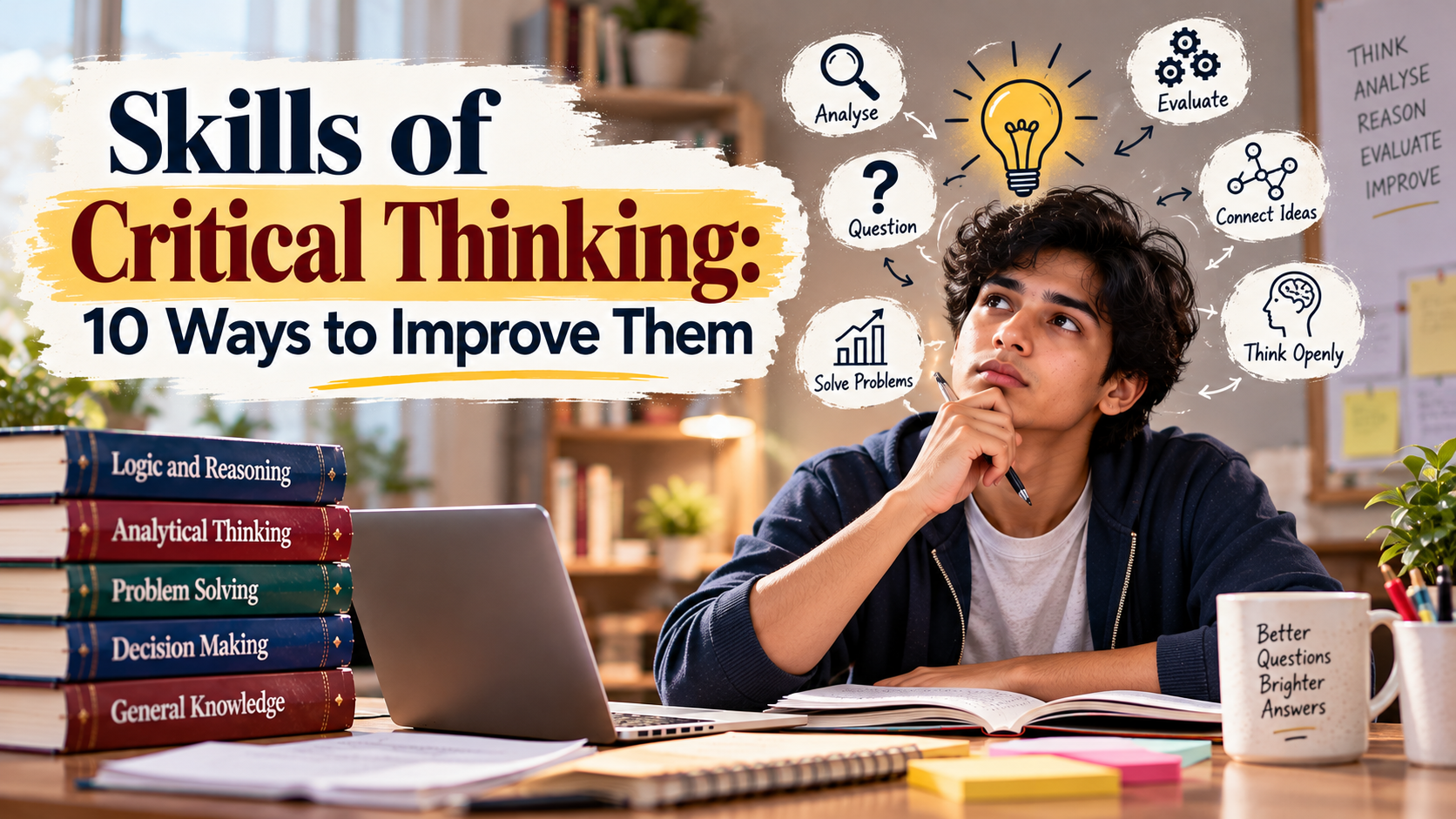
Skills of Critical Thinking: 10 Ways to Improve Them
Critical thinking means examining information, checking whether evidence supports a claim, and reaching a reasoned conclusion. The skills of critical thinking help you make decisions, solve problems, recognise weak arguments, and avoid accepting claims simply because they sound convincing. You can practise them by asking questions, checking sources, considering alternatives, and reviewing your choices.
For students, these habits help with analysing passages, comparing viewpoints, preparing arguments, and deciding which information matters. At work and at home, they help separate facts from assumptions. This guide explains the main skills and ways to practise them.
Core Critical Thinking Skills
The skills of critical thinking help you assess information, understand different viewpoints, and make decisions based on evidence rather than assumptions.
- Analytical Thinking: Examining information, separating relevant facts from distractions, and comparing sources to understand an issue.
- Open-Mindedness: Considering alternative ideas, different viewpoints, and contradictory evidence without prejudice.
- Problem-Solving: Breaking complex problems into smaller parts, identifying root causes, and choosing practical solutions.
- Inference and Research: Gathering credible information, recognising patterns, and drawing logical conclusions from available evidence.
- Self-Reflection: Reviewing your thought process, recognising personal biases, and changing your opinion when new evidence appears.
How to Develop These Skills
You can improve critical thinking skills through regular practice in your studies, work, and everyday decisions.
- Ask Inquisitive Questions: Ask questions such as “What do I know?”, “How do I know this?” and “What assumptions am I making?” before reaching a conclusion.
- Seek Contrasting Views: Look for evidence or arguments that challenge your existing beliefs. Comparing perspectives helps you evaluate information more fairly.
- Practise Active Listening: Pay attention to others, ask open-ended questions, and assess their reasoning before agreeing or disagreeing.
What Are the Skills of Critical Thinking? A Critical Thinking Skills List
Critical thinking combines skills used to understand information, judge its quality, draw conclusions, and review your reasoning. Common elements include analysis, interpretation, evaluation, inference, explanation, and self-regulation. The OECD also links critical thinking with reasoning, evaluation, problem-solving, and learning.
Here is a practical critical thinking skills list and what each skill looks like in action:
- Analytical thinking: break a claim or problem into smaller parts and identify how those parts relate.
- Interpretation and evaluation: explain what information means, then judge whether it is relevant, reliable, and sufficient.
- Logical reasoning and inference: connect evidence to a conclusion without making leaps that the evidence cannot support.
- Problem-solving and decision-making: define the issue, compare possible responses, and choose one for defensible reasons.
- Open-mindedness and self-regulation: consider opposing views, notice personal bias, and revise a judgement when stronger evidence appears.
- Communication and active listening: understand another person’s reasoning and explain your own conclusion clearly.
These skills often work together. Checking a news claim may require interpreting the statement, evaluating its source, comparing evidence, and noticing your own preferences. Strong critical thinkers use the skills together rather than as separate boxes.
Critical thinking is not fault-finding. It means matching your confidence to the available evidence and admitting when more information is needed right now in a given situation.
Why Are Critical Thinking Skills Important?
Critical thinking matters because decisions often involve incomplete or conflicting information. A confident speaker may be wrong, a popular opinion may rest on weak reasoning, and a quick solution may create new problems. A clear process helps you identify what is known and what still needs checking.
How Critical Thinking Improves Decision-Making
Comparing options against clear criteria reduces the chance of choosing something only because it is familiar or popular. When choosing a course, compare its curriculum, cost, schedule, student support, and evidence of outcomes. Personal preference still matters, but you will understand your reasons.
How Critical Thinking Helps You Evaluate Information
Critical thinking helps you assess posts, news reports, advertisements, and claims shared by friends. Ask who made the claim, what evidence supports it, when it was published, and whether credible sources agree. Be especially careful with emotional headlines or single examples presented as proof.
The goal is not to distrust everything. It is to match your confidence to the quality of the evidence and remain willing to update your view.
How to Improve Critical Thinking Skills: 10 Practical Methods
Practise these methods on real questions. Choose a small situation each day and apply one or two methods. The goal is a repeatable habit, not overanalysing every ordinary choice.
1. Ask Questions Before Accepting Information
Clarify the claim first. What exactly is being said? Is it a fact, interpretation, prediction, or opinion? Ask what would need to be true for it to hold. Clear questions prevent you from reacting before you understand the statement.
For example, if someone says, “Students learn better with longer study hours,” ask what “better” means. Does it refer to test scores, retention, or understanding? Does the claim apply to all students, and what evidence supports it? A more precise question is easier to investigate than a sweeping statement.
2. Check Evidence and Verify Sources
Look beyond a headline, screenshot, or short clip. Find the original report when possible and check the author, date, evidence, and purpose. A source may be accurate about one detail but incomplete about the wider issue. Check whether numbers have context, whether the sample is large enough, and whether the evidence actually supports the conclusion.
For important claims, compare independent, credible sources. Repeated copies of the same unverified post are not independent confirmation. In academic work, use sources with identifiable expertise and references. Monash University advises students to question sources and analyse arguments rather than accept information at face value.
3. Identify Your Assumptions and Biases
An assumption is something you accept without checking it in the current situation. Bias can influence which details you notice, which sources you trust, and how you interpret another person’s actions. Everyone has preferences and prior beliefs; the useful skill is noticing when they may affect your judgement.
Write down what you believe, why you believe it, and what evidence could change your mind. If a classmate misses one deadline, consider other explanations before deciding they are careless. Ask whether you would judge the same behaviour differently if someone else did it.
4. Consider Different Perspectives
Before making a judgement, describe how the issue might look to someone with different information, priorities, or experience. This does not mean every viewpoint is equally well supported. It means understanding the strongest reasonable version of another position before you assess it.
In a group project, one person may prefer speed while another prioritises accuracy. Instead of labelling one impatient and the other slow, identify each concern. You may be able to test the idea quickly while checking its main risks.
5. Break Complex Problems into Smaller Parts
A problem can feel impossible when it is treated as one large question. Divide it into smaller questions: What is happening? When did it begin? Who or what is affected? Which facts are known? Which factors might be causing it? What can be changed? This makes it easier to see where the evidence is missing.
If your practice-test score falls, do not assume you are bad at the subject. Check whether errors came from misunderstanding, missing a detail, poor time management, or rushing. Each cause requires a different response.
6. Practise Logical Reasoning
Logical reasoning means checking whether a conclusion follows from the reasons given. Look for unsupported jumps, contradictions, false comparisons, and claims that confuse correlation with cause. Two events occurring together does not automatically mean one caused the other. One successful example does not prove that a method works in every situation.
When reading an argument, identify its main claim, supporting reasons, and conclusion. Check whether the reasons are relevant and sufficient. Students preparing for entrance examinations can practise this with passage-based questions. CLATapult’s CLAT preparation resources may help readers seeking structured law entrance preparation.
7. Listen Actively and Discuss Ideas
Good reasoning depends on understanding what another person actually means. Listen without preparing your rebuttal while they are speaking. Summarise their point in your own words and ask whether you have understood it correctly. Then respond to the argument, not to a version you have made easier to dismiss.
A useful discussion is not about winning. Ask, “What evidence led you to that conclusion?” or “Would your view change if this detail were different?” Such questions reveal the reasoning behind a position. If the other person has a stronger argument, acknowledge it.
8. Compare Alternatives Before Making Decisions
Avoid treating the first workable idea as the only option. List at least two alternatives, then compare them using criteria that matter for the decision. These might include cost, time, accuracy, fairness, risk, or long-term consequences. Give each option the same scrutiny rather than looking only for reasons to support your favourite.
When planning revision, compare longer sessions with shorter sessions spread across the week. Consider your attention, topics, and how you will test recall. Try a schedule and adjust it based on results instead of instinct alone.
9. Solve Logic Puzzles and Real-World Problems
Puzzles can help you practise spotting patterns, following conditions, and checking whether a conclusion is valid. They are useful practice, but solving puzzles alone will not make every real-world judgement sound. Apply the same habits to ordinary decisions: compare bills, plan a route, interpret a chart, or decide whether a claim in a group chat is credible.
After solving a puzzle, explain how you reached the answer. Which clue mattered, and why did you rule out another possibility? If you were wrong, find the step where your reasoning stopped matching the evidence.
10. Review Your Decisions and Learn from Mistakes
After an important decision, take a few minutes to review it. What information did you have at the time? Which assumptions did you make? What did you overlook? Did the outcome match your expectations? Separate a poor decision from a poor outcome: sometimes a reasonable choice leads to an unlucky result, and sometimes a careless choice works out by chance.
Keep a short decision journal with the decision, evidence used, and lesson learned. Over time, you may spot habits such as rushing, trusting one source, or avoiding evidence that challenges your view.
What Is a Critical Thinking Example in Real Life?
Suppose a post claims that a study method doubles exam scores. Before sharing it or changing your routine, check who conducted the study, how many students took part, what “doubles” means, and whether the result was independently examined. Then decide whether to test the method on a small scale.
Critical Thinking Example at Work
A team notices more customer complaints. Instead of blaming staff, it compares complaint categories, dates, product changes, and response times. The evidence points to one changed process. The team tests a revision and checks whether complaints fall.
Critical Thinking Example in Everyday Life
You are choosing between two phone plans. One advertises a low monthly price, but the other includes more data and fewer extra charges. You compare the full contract, likely usage, coverage, and cancellation terms instead of choosing from the headline price. The decision is critical thinking because it uses relevant evidence and clear criteria.
Critical Thinking Example for Students
A passage argues that school uniforms improve academic performance. A student identifies the main claim, checks the reasons offered, and asks whether the evidence shows that uniforms caused better performance or merely appeared alongside other changes. The student also considers alternative explanations, such as school resources or attendance. This is stronger than agreeing or disagreeing based only on personal preference.
How to Improve Critical Thinking and Problem Solving Skills
Learning how to improve critical thinking and problem solving skills can help students analyse complex questions, identify logical connections, evaluate evidence, and choose the most appropriate answer.
Identify the Root Cause of a Problem
Describe the problem in observable terms. Replace “I am terrible at reasoning” with “I missed four questions because I selected answers before checking the passage.” Look for patterns and ask what could explain them. Avoid treating the first possible cause as a proven cause.
Evaluate Possible Solutions Using Evidence
List realistic solutions and the evidence that supports each one. Consider the time, resources, risks, and possible side effects. If you do not have enough information to choose confidently, identify the smallest useful test you can run.
Test a Solution and Review the Results
Try the solution for a defined period and decide in advance what success would look like. For a study method, that might mean fewer repeated errors or better recall after a week. Review the results honestly. Keep what works, change what does not, and avoid claiming success from one unusual result.
How to Improve Critical Thinking Skills for Students
Students can practise critical thinking in class, while reading, during group work, and when preparing for exams. The aim is not to challenge every instruction or make simple tasks complicated. It is to understand ideas, recognise evidence, and explain why an answer is justified.
Analyse Arguments Instead of Memorising Answers
When you read an explanation, identify its main point and the reasons supporting it. Ask whether the reasons connect to the conclusion. If an answer key says an option is correct, study why it fits the passage and why the other options do not. This makes practice useful even when the next question looks different.
Compare Sources When Researching a Topic
Use more than one credible source when a topic is disputed or important. Check the publication date, author expertise, evidence, and purpose. Separate what the source directly establishes from what you infer from it. Record the source details so you can return to the original information rather than relying on memory.
Practise Debates, Case Studies and Reflective Writing
Debates teach you to explain a position and respond to objections. Case studies ask you to apply ideas to a specific situation. Reflective writing helps you identify where your reasoning was strong or weak. After each activity, write down one assumption you tested and one piece of evidence that influenced your conclusion.
Students preparing for law entrance examinations can use passage-based questions to practise identifying claims, assumptions, implications, and conclusions. For additional study guidance, explore the relevant CLAT preparation resources and use practice questions to check whether your reasoning holds up under time limits.
What Does Critical Thinking Skills Training Involve?
Critical thinking skills training does not have to mean a formal course. It can involve guided practice, feedback, discussion, and reflection. A useful activity gives you a question to investigate, asks you to explain your reasoning, and lets you compare your approach with other possible answers.
Critical Thinking Exercises You Can Practise at Home
Try one of these short exercises:
- Claim check: choose a statement you saw online and trace it to its original source.
- Two-sided argument: write the strongest reason for and against a decision before choosing.
- Fact or inference: mark each sentence in a short article as a directly supported fact, an interpretation, or an unsupported claim.
- Decision review: revisit a recent choice and identify the evidence you used and what you would check next time.
- Explain the answer: solve a puzzle, then describe each step and the clue that supports it.
The key is to explain your reasoning. If you cannot say why a conclusion follows, return to the evidence or identify the missing information.
Group Discussions, Case Studies and Problem-Solving Activities
A group can expose assumptions that one person misses. Give everyone time to explain their reasoning, ask the group to distinguish evidence from opinion, and invite someone to suggest an alternative explanation. For a case study, define the problem, list the known facts, note what remains uncertain, compare options, and explain the trade-offs in the final choice.
How to Practise Critical Thinking in Everyday Situations
Use small decisions as practice. Before buying something, compare the total cost and the features you will use. Before forwarding a message, verify its source. Before reacting to criticism, check what was actually said and whether there is useful feedback in it. These short exercises make critical thinking part of ordinary life rather than a separate academic task.
How to Increase Your Critical Thinking Skills with a 7-Day Practice Plan
Use this plan as a starting point. Spend about 10–15 minutes each day, and choose examples from your studies, work, or daily life. Keep a note of the question you asked, the evidence you checked, and what you concluded.
Day 1: Question Your Assumptions
Choose one belief you hold about a subject or situation. Write down what you know, what you have assumed, and what evidence could challenge your view.
Day 2: Verify a Claim
Find a claim in a post, article, or conversation. Locate the original source, check its date and author, and compare it with one independent source.
Day 3: Compare Different Perspectives
Choose a decision or debate. Write a fair summary of two different positions before deciding which is better supported.
Day 4: Solve a Logic Problem
Complete one reasoning puzzle or passage-based question. Explain why the correct answer fits the evidence and why the strongest alternative does not.
Day 5: Analyse a Real-Life Situation
Break a current problem into facts, possible causes, and unanswered questions. Do not confuse a possible explanation with a proven cause.
Day 6: Evaluate a Decision
Compare two options using three criteria, such as cost, time, and likely outcome. Write down why you chose one and what risk remains.
Day 7: Reflect on What You Learned
Review your notes from the week. Identify one habit that helps and one that needs work. Set a small target for the next week, such as checking sources before sharing claims or reviewing every incorrect practice answer.
Repeat the plan with different examples rather than trying to master every skill in seven days. Improvement comes from using the process repeatedly and learning from feedback.
Frequently Asked Questions About Critical Thinking Skills
What Are the 7 Skills of Critical Thinking?
A critical thinking skills list commonly includes analysis, interpretation, evaluation, inference, explanation, problem-solving, and self-regulation. These skills help people examine evidence and reach reasoned conclusions.
What Are Some Critical Thinking Skills Examples?
A critical thinking example in real life is checking a news source before sharing a claim or comparing evidence before making a decision. For students, it can mean analysing an argument rather than memorising an answer.
What Are the Main Types of Critical Thinking?
Common critical thinking types include analytical, logical, reflective, creative, and evaluative thinking. Each helps you examine information or approach a problem from a different angle.
How Are Critical Thinking Skills Used in Psychology?
Critical thinking skills in psychology help people assess research, recognise cognitive biases, and distinguish evidence-based findings from assumptions about human behaviour.
How Can Critical Thinking Skills Training Help?
Critical thinking skills training uses exercises, case studies, discussions, and evidence-based tasks to strengthen reasoning. Regular practice can help you improve critical thinking skills in academic, professional, and everyday situations.
Why Are Critical Thinking Skills Important as Life Skills?
Critical thinking is one of the essential life skills because it supports informed decisions, practical problem-solving, and careful evaluation of information.
Strengthen Your Critical Thinking Skills for CLAT

CLAT is not just about knowing the right answer; it is about understanding passages, identifying arguments, drawing logical inferences, and evaluating information under time pressure. Strengthening your critical thinking skills can help you approach the English Language, Current Affairs, and Logical Reasoning sections with greater clarity and confidence.
Preparing for CLAT? Build these skills through focused practice and expert guidance. Contact our team to find the right support for your preparation journey.