
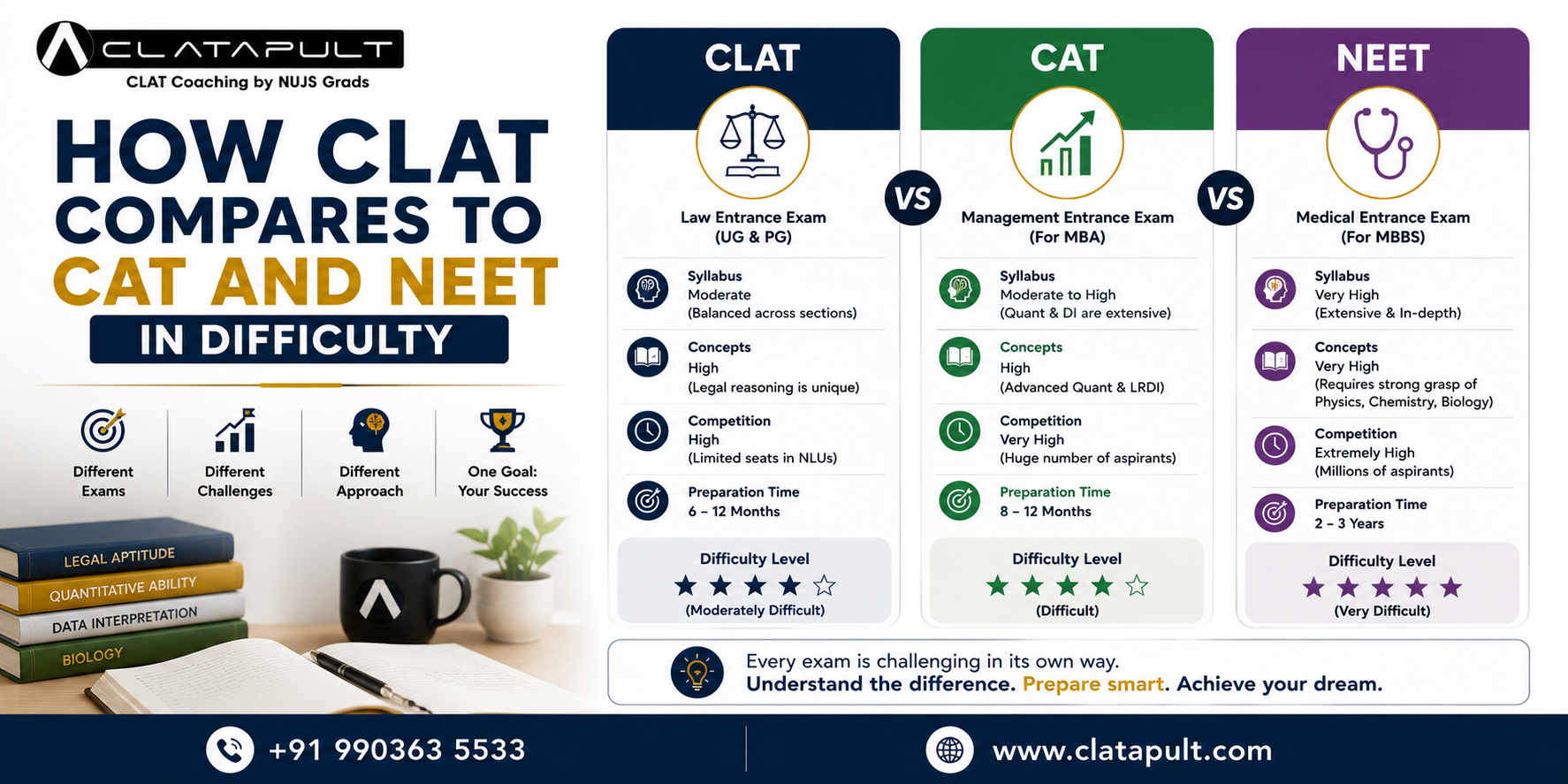
CLAT vs CAT vs NEET Difficulty
Every year, lakhs of students walk into three very different exam halls hoping to change the direction of their lives. Some are chasing a seat at an IIM through CAT. Some are chasing a seat in a medical college through NEET. And a growing number are chasing a seat at a National Law University through CLAT. Naturally, this leads to endless comparisons on forums, in coaching centres, and around dinner tables: which of these three exams is actually the hardest?
The honest answer is that “hardest” depends on what kind of hard you’re talking about. CAT tests speed and decision making under brutal time pressure. NEET tests the sheer volume of content a student can retain and recall accurately. CLAT tests reading stamina, reasoning ability, and the discipline to stay updated with the world around you. This article breaks down all three exams side by side so you can understand exactly where CLAT stands, and why comparing it to CAT or NEET on a single difficulty scale rarely tells the full story.
Why Students Even Compare CLAT, CAT, and NEET
Class 11 and 12 students, and sometimes even their parents, often try to benchmark CLAT against exams they’ve already heard a lot about, since CAT and NEET have been part of India’s competitive exam vocabulary for decades. If you’re a student trying to decide between medicine, management, or law, or simply trying to gauge how much effort CLAT preparation demands compared to something as famously tough as NEET, this comparison genuinely helps set realistic expectations.
It also matters for students who are choosing between streams at the Class 11 stage. A science student weighing NEET against a switch to law, or a commerce student wondering whether CAT after graduation might be a smoother road than CLAT right after Class 12, both need an honest, structural comparison rather than hearsay.
What Each Exam Is Actually Testing
CLAT: Reading, Reasoning, and Current Affairs
CLAT, the Common Law Admission Test, is the gateway exam for over twenty National Law Universities across India. It is a two-hour test built almost entirely around reading comprehension. Every section, whether it’s English, Current Affairs, Legal Reasoning, Logical Reasoning, or even Quantitative Techniques, is delivered through a passage that you must read, interpret, and answer questions on. There is very little scope for rote memorisation. If you want the full breakdown of what each section covers, our detailed guide to the CLAT exam syllabus walks through every topic tested.
CAT: Speed, Data, and Decision Making
CAT, the Common Admission Test, is the entrance exam for India’s Institutes of Management, including the coveted IIMs. It tests Verbal Ability and Reading Comprehension, Data Interpretation and Logical Reasoning, and Quantitative Ability. CAT is famous for its brutal time constraints, where candidates often have to make quick calls on which questions to attempt and which to abandon within seconds, since even strong students cannot realistically finish the entire paper.
NEET: Memory, Precision, and Volume
NEET, the National Eligibility cum Entrance Test, is the single gateway to almost every medical college in India, covering Physics, Chemistry, and Biology. Unlike CLAT or CAT, NEET leans heavily on memorised content straight from the NCERT syllabus. Success in NEET depends far more on how thoroughly a student has revised three years of dense science content than on reasoning speed.
Difficulty Level: Breaking It Down by Category
Syllabus Size and Depth
NEET wins this category by a wide margin. The syllabus spans Class 11 and 12 Physics, Chemistry, and Biology in complete depth, and questions are drawn from every corner of the NCERT textbooks. A single missed chapter can genuinely cost a student dozens of marks.
CAT, by comparison, does not have a fixed syllabus in the traditional sense. It tests aptitude built over years of reading habits, numerical fluency, and logical thinking rather than a defined set of chapters.
CLAT sits somewhere between the two. It has a defined structure across five sections, but within that structure, the depth required is far shallower than NEET. You are not expected to memorise the Indian Constitution article by article or every legal doctrine in existence. Instead, CLAT expects you to apply general legal principles to a new fact situation presented in a passage, which is a skill built through practice rather than memorisation. Our guide on how to prepare for quantitative aptitude for CLAT is a good example of how even the maths-heavy section of CLAT stays conceptually light compared to a full-fledged exam like CAT or NEET’s physics and chemistry.
Time Pressure
CAT is widely regarded as one of the most time-pressured exams in India. With a fixed number of minutes allotted to each of its three sections and no flexibility to move time between them, candidates cannot linger on a tough question the way they might in other exams.
NEET gives candidates roughly a minute per question on average, which sounds generous until you factor in how long it takes to solve certain numerical problems in Physics and Chemistry under exam stress.
CLAT gives you two hours for 120 questions, which works out to almost exactly one minute per question. Because CLAT allows you to move freely between sections and mark questions for review, many students find the time pressure more manageable than CAT’s rigid, sectional time limits. That said, CLAT’s own version of pressure lies in reading speed. If you read slowly, you will run out of time regardless of how much you know. We’ve written in detail about how the ideal time split works for each CLAT section if you want a section-by-section breakdown.
Number of Applicants vs Number of Seats
This is where the real competitive intensity of each exam becomes clear.
NEET attracts the largest applicant pool of the three, with well over twenty lakh students competing for a comparatively small number of MBBS seats across government and private medical colleges. The sheer scale of competition, combined with the depth of syllabus, is what makes NEET so gruelling.
CAT typically sees around two to three lakh test takers competing for a limited number of seats across the IIMs and other top B-schools, with the very top IIMs admitting only a few hundred students each.
CLAT, by comparison, sees roughly sixty to seventy thousand applicants competing for around three thousand undergraduate seats across NLUs, a number that keeps expanding slightly as new NLUs join the Consortium. You can read more about the exact seat numbers in our detailed post on how many seats CLAT actually has. While the applicant pool for CLAT is smaller than NEET or CAT, the competition for the very top NLUs, such as NLSIU Bangalore or NALSAR Hyderabad, remains extremely intense, since only a few hundred candidates can secure a seat at each of these flagship institutions.
Nature of Preparation Required
NEET preparation is a marathon of content mastery. Students typically spend two full years, often starting from Class 11, systematically working through Physics, Chemistry, and Biology, with constant revision cycles to keep the volume of information fresh.
CAT preparation is usually shorter in duration but extremely intense, often compressed into six to twelve months after graduation, focused heavily on practising speed, accuracy, and strategic question selection through mock test after mock test.
CLAT preparation blends both approaches. It demands consistent reading habits built over months, similar to NEET’s steady grind, but it also demands the kind of strategic mock test practice that CAT aspirants rely on. Many CLAT toppers describe their preparation as less about memorising facts and more about training their brain to read faster and think more clearly under pressure. If you’re wondering whether CLAT preparation is genuinely as hard as it sounds, our article on whether clearing CLAT is difficult unpacks this question directly, with an honest look at what makes the exam challenging and what doesn’t.
Negative Marking and Risk Management
All three exams penalise wrong answers, but the extent differs. NEET deducts one full mark for every incorrect answer, which is a steep penalty given that each question also carries four marks. CAT’s negative marking applies only to multiple choice questions and is generally less punishing than NEET’s. CLAT deducts a quarter mark for every wrong answer, which is comparatively lighter, though still significant given how many questions are on the paper. Managing this risk intelligently is a skill in itself, and our complete breakdown of CLAT’s negative marking system explains exactly how to protect your score from careless attempts.
Which Exam Is “Hardest”: A Fair Verdict
If difficulty means sheer volume of content to memorise, NEET is the toughest of the three.
If difficulty means the speed and precision required to make split-second decisions under a punishing clock, CAT takes that crown.
If difficulty means the discipline required to build strong reading habits, stay updated with current affairs every single day for months, and apply logic to unfamiliar situations rather than recall memorised facts, CLAT presents its own distinct, demanding challenge.
None of these exams is objectively “easier” than the others once you account for what each one is actually measuring. A brilliant NEET aspirant with an excellent memory might struggle initially with CLAT’s emphasis on quick comprehension and reasoning, just as a strong CLAT candidate might find NEET’s sheer content load overwhelming without dedicated science preparation. The exams simply reward different cognitive strengths.
What This Means If You’re Choosing Between Streams
If you’re a Class 11 student trying to decide whether law, medicine, or management is the right long-term path, difficulty level alone should not drive that decision. Instead, ask yourself which kind of daily grind actually excites you. If you enjoy reading newspapers, following current events, and thinking through arguments, CLAT preparation will likely feel far more natural to you than memorising the Krebs cycle for NEET. If you love numbers and thrive under strict time limits, aptitude-heavy exams like CAT might suit your temperament better later in life.
It’s also worth remembering that CLAT is unique among the three in that it is typically attempted straight after Class 12, without requiring an undergraduate degree first, unlike CAT which almost always comes after graduation. This makes CLAT one of the earliest high-stakes entrance exams a student in India will face, which adds its own layer of pressure since 17 and 18 year olds are making a serious career decision with comparatively less life experience than a CAT aspirant applying in their twenties.
How CLATapult Helps You Prepare for CLAT the Right Way

Whatever exam you eventually choose to pursue, if CLAT is on your radar, preparing with the right guidance makes an enormous difference to how manageable the exam feels. CLATapult has been Eastern India’s number one ranked CLAT coaching institute for over nine years, built entirely by NUJS Kolkata law students who cracked the exam themselves and understand exactly what a CLAT aspirant is up against.
Our courses cover every section of the exam in depth, backed by hundreds of mock tests, monthly current affairs magazines, and doubt-clearing support from mentors who have walked the exact same path. If you’re wondering whether to go for self-guided preparation or structured coaching, our detailed comparison of self-study versus coaching for CLAT can help you make that call with confidence.
Explore our CLAT coaching courses to find the programme that fits your preparation timeline, or book a free demo class with CLATapult today and experience firsthand what focused, expert-led CLAT preparation actually looks like.
Frequently Asked Questions on CLAT vs CAT vs NEET Difficulty
Is CLAT easier than NEET?
CLAT and NEET test very different skills, so calling one easier than the other is misleading. NEET demands memorising a vast science syllabus across Physics, Chemistry, and Biology, while CLAT focuses on reading comprehension, reasoning, and current affairs with a comparatively lighter content load. Students with strong reading and analytical skills often find CLAT more manageable than NEET’s sheer volume of content.
Is CLAT tougher than CAT?
CLAT and CAT are tough in different ways. CAT is known for extreme time pressure and requires very fast decision making across quantitative and logical sections. CLAT gives candidates more flexibility to move between sections but demands strong reading speed and current affairs awareness built over several months. Neither is universally tougher than the other, since the two exams reward different strengths.
Which exam has the toughest competition, CLAT, CAT, or NEET?
NEET has by far the largest number of applicants, often exceeding twenty lakh candidates each year, making it the most competitive in terms of sheer applicant volume. CLAT sees around sixty to seventy thousand applicants competing for roughly three thousand NLU seats, while CAT typically has two to three lakh test takers. However, competition for the very top institutes remains intense across all three exams.
How many months of preparation does CLAT need compared to CAT and NEET?
NEET preparation usually spans two years starting from Class 11. CAT preparation is often compressed into six to twelve months after graduation. CLAT preparation timelines vary, but most serious aspirants begin eight to twelve months before the exam, with a strong emphasis on daily reading habits and consistent mock test practice.
Does CLAT have negative marking like CAT and NEET?
Yes, all three exams have negative marking, though the extent differs. NEET deducts one full mark per wrong answer, CAT’s negative marking applies to multiple choice questions, and CLAT deducts a quarter mark for every incorrect answer, making CLAT’s penalty comparatively lighter than NEET’s.
Is CLAT good for students who are not good at maths, unlike CAT?
Yes. CLAT’s Quantitative Techniques section carries far less weight than CAT’s quantitative sections and focuses mainly on basic arithmetic and data interpretation rather than advanced mathematics, making CLAT considerably more accessible for students from a non-maths background compared to CAT.