
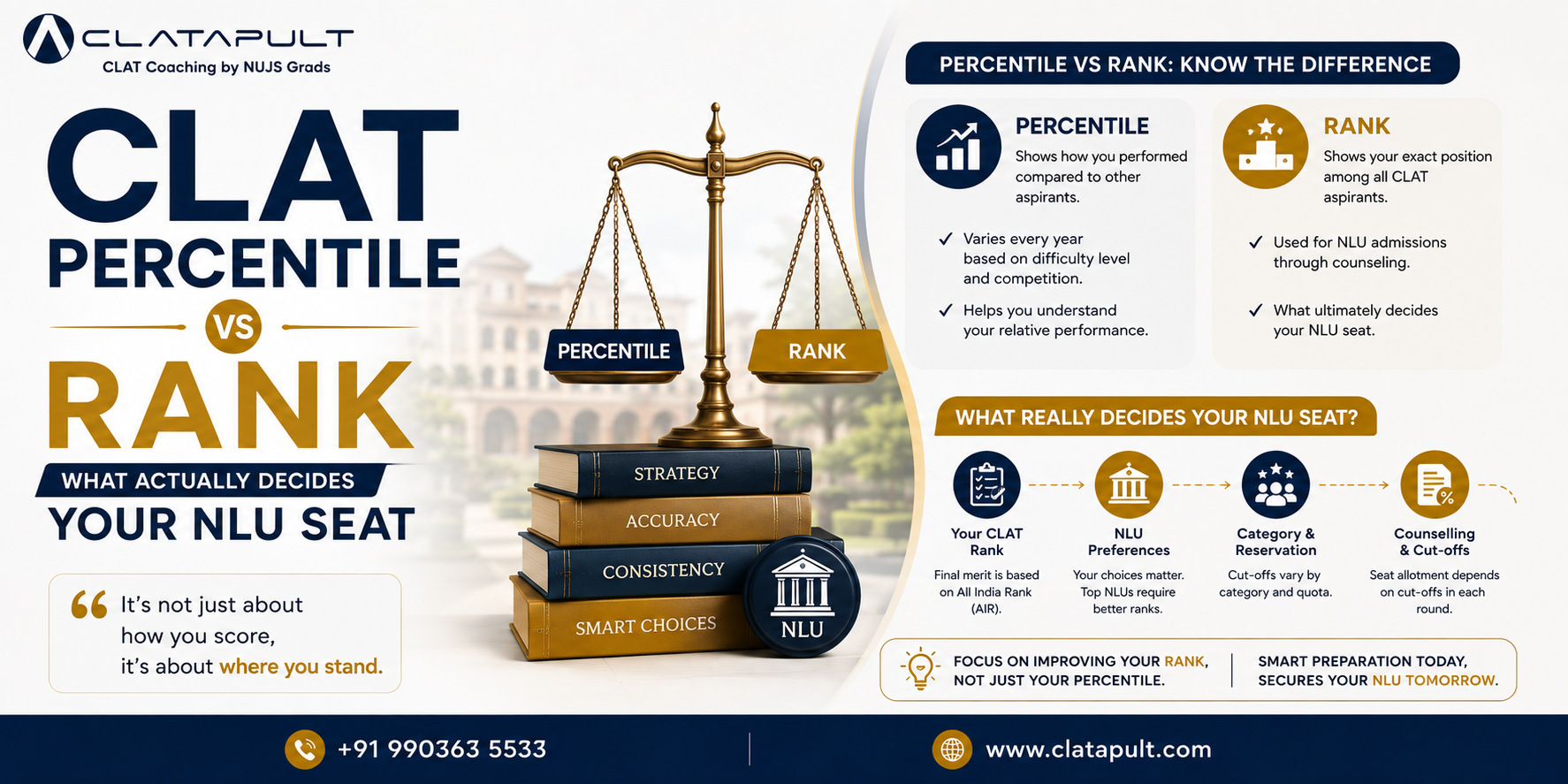
CLAT Percentile vs Rank: What Actually Decides Your NLU Seat
The day CLAT results are declared, thousands of students open their scorecard and stare at three different numbers: their marks, their percentile, and their rank. And almost immediately, the confusion begins. Some students see a 99 percentile and assume they’re guaranteed a top NLU. Others panic over a rank that sounds high, without realising what that rank actually means for their category. If you’ve ever wondered why two students with what looks like a “similar” score end up at completely different law schools, this article will clear that up.
Understanding the real difference between percentile and rank, and knowing which one your NLU admission actually depends on, can save you from a lot of unnecessary panic during results season and help you fill your counselling preferences far more intelligently.
What Is CLAT Percentile?
Percentile is a statistical measure that tells you how you performed relative to every other candidate who appeared for the exam. If you scored in the 95th percentile, it means you performed better than 95 percent of all the students who took CLAT that year. Percentile is calculated based on the total number of candidates and your relative position among them, not on a fixed marks cutoff.
Percentile gives you a quick, high-level sense of where you stand nationally. It’s the kind of number that looks impressive on paper and is often what students share first with friends and family, since a 99 percentile sounds unambiguously excellent. But percentile alone tells you almost nothing about which specific NLU you can actually get into.
What Is CLAT Rank?
Rank, specifically your All India Rank (AIR), is the exact numerical position you hold among all candidates based on your marks, after tie-breaking rules are applied. If you have AIR 150, it means there are exactly 149 candidates who scored higher than you in the entire country.
Alongside your AIR, your scorecard also shows a category rank, which reflects your position specifically within your reservation category, such as OBC, SC, ST, EWS, or PwD. For many candidates, this category rank matters far more than the overall AIR, since a large portion of NLU seats are reserved and allotted based on category-wise merit rather than the general list alone.
The Core Difference: Why Percentile and Rank Are Not the Same Thing
Here’s the simplest way to understand it. Percentile tells you how well you performed compared to everyone else, expressed as a relative percentage. Rank tells you your exact position on the merit list. Two students can have percentiles that look nearly identical, say 99.1 and 99.3, while their actual ranks differ by several hundred positions, because CLAT has become so densely competitive at the top that even a fraction of a mark can shift dozens of ranks.
This is exactly why a 99 percentile does not automatically mean a top-five NLU. At the upper end of CLAT’s score distribution, the relationship between marks and rank stops being linear. Thousands of aspirants cluster within a narrow band of marks near the top, so a difference of half a mark can move you thirty or forty ranks in either direction. Percentile smooths over this clustering effect, while rank reflects it with brutal precision.
Why Rank, Not Percentile, Actually Decides Your NLU Seat
Here’s the part every CLAT aspirant needs to internalise clearly: NLU counselling and seat allotment run entirely on rank, not percentile. When the Consortium of NLUs processes seat allotment, it works strictly through the All India Rank list and category-wise rank lists. Percentile plays no direct role in this process. It exists purely as a reference figure on your scorecard to help you understand your relative standing, not as an admission criterion.
This means a student obsessing over their percentile after results, without checking their actual AIR and category rank, is looking at the wrong number entirely. Your real question after CLAT results should never be “what percentile did I get.” It should be “what is my AIR, and more importantly, what is my rank within my specific category and any applicable domicile quota.”
Why Two Students With the “Same” Percentile Can Get Different NLUs
This confuses almost every aspirant during results season, so it’s worth unpacking properly.
Category matters enormously. A general category candidate and an OBC or SC category candidate with the exact same marks will usually end up with very different AIRs and, more importantly, very different category ranks. Since a significant share of seats at every NLU is reserved for specific categories, a candidate’s category rank often determines their admission chances far more directly than their overall AIR.
Domicile and home state quotas matter too. Several NLUs reserve a portion of seats specifically for candidates domiciled in their home state. NLU Odisha, for example, reserves seats for Odisha residents, and similar domicile reservations exist at other state-linked NLUs. Two students with identical marks, one belonging to the relevant state and one not, can end up with completely different outcomes at that particular university.
Gender-based reserved seats exist at some NLUs. Certain law schools maintain separate reserved seats for female candidates, which again changes how the same mark translates into an actual seat, depending on which specific quota a candidate falls under.
The exam’s difficulty level shifts the whole distribution every year. CLAT’s difficulty varies from year to year, which means the marks required for a particular rank in one year can look completely different the next year. This is exactly why relying on last year’s cutoff numbers as a fixed benchmark can be misleading, and why understanding trend ranges matters more than memorising a single number.
How to Read Your CLAT Scorecard Correctly
When your CLAT result is declared, your scorecard will typically show four key figures: your total marks, your percentile, your All India Rank, and your category rank (if applicable). Here’s how to prioritise them for counselling purposes.
Start with your category rank, since this is what determines your realistic chances at NLUs where reserved seats apply. Then check your All India Rank, since this is what matters for open category seats across every NLU. Use your percentile only as a general sense check of your overall performance, not as a planning tool for counselling. Marks matter mainly as the raw input that determines both your rank and category rank, so while your absolute score is worth knowing, it should not be the number you obsess over once results are out.
If your CLAT preparation is still ahead of you and you’re trying to understand exactly how the exam is scored before you even get to this stage, our detailed guide on CLAT’s negative marking system explains precisely how correct and incorrect answers translate into your final marks, which is the starting point for everything discussed here.
Using Rank to Plan Your NLU Preference List
Once results are out, the real strategic work begins during counselling, where you list your preferred NLUs in order. This is where understanding your rank properly becomes essential, not just academically interesting.
A useful approach is to divide your preference list into three tiers based on your actual category rank trends from recent years. List your ambitious choices first, the NLUs you have a realistic but competitive shot at. Follow with your safe choices, NLUs where your rank comfortably falls within recent closing ranks. Finally, include a few backup options in case ranks shift unexpectedly in later counselling rounds.
Remember that CLAT counselling happens over multiple rounds, and closing ranks for several NLUs often move in Round 2 or Round 3 as higher-ranked candidates who secured admission elsewhere withdraw their earlier choices. A rank that looks out of reach in Round 1 sometimes becomes viable in later rounds, so it’s worth staying patient rather than panicking immediately after the first allotment list.
If you’re still building your understanding of the exam structure itself before you reach results season, our comprehensive CLAT exam syllabus guide is a good place to start, since a strong grasp of the syllabus and marking scheme directly shapes the marks, and eventually the rank, you’ll be working with.
Common Mistakes Aspirants Make When Reading Their Results
Focusing only on percentile and ignoring rank entirely. As covered above, percentile is a relative statistical figure, while rank is what actually drives admission. Treating a high percentile as a guarantee of a specific NLU is one of the most common misreadings of a CLAT scorecard.
Ignoring category rank in favour of overall AIR. For a large number of candidates, category rank is the number that truly determines their admission chances, yet many students fixate solely on their AIR without checking how their category-specific position compares to past closing ranks.
Assuming cutoffs stay identical every year. Since CLAT’s difficulty level and the number of test-takers change annually, the marks required for a given rank shift from year to year. A rank that would have secured a particular NLU two years ago may not do the same this year, and vice versa.
Panicking after a single counselling round. Since ranks and seat availability shift across multiple rounds, drawing final conclusions from Round 1 alone often leads to unnecessary stress and rushed decisions.
If your results didn’t come out the way you hoped and you’re now reconsidering your preparation timeline, our guide on CLAT preparation strategy for droppers offers an honest, structured way to approach a second attempt without repeating the same gaps from your first one.
Why Understanding This Matters Long Before Results Day
Most aspirants only start thinking seriously about percentile and rank once results are declared, but understanding how CLAT’s marks-to-rank relationship works is genuinely useful earlier in your preparation too. It helps set realistic score targets rather than vague ones. Instead of telling yourself “I need a good percentile,” you can work backward from actual rank data for your target NLUs and set a specific marks range to aim for during your mock test practice.
This is exactly the kind of strategic clarity that regular, well-analysed mock testing builds over time. If you’re unsure how many mocks you should be taking or how to interpret them properly as your preparation progresses, our article on self-study versus coaching for CLAT discusses how structured guidance, including consistent mock analysis, helps aspirants track their progress against realistic rank benchmarks rather than guessing in the dark.
How CLATapult Helps You Prepare With Rank-Focused Clarity

At CLATapult, we don’t just prepare students to score well on paper, we help them understand exactly how those scores translate into real rank outcomes and real NLU seats. Our mock tests are built and analysed the same way the actual CLAT exam is scored, so students get a realistic sense of where they stand well before the actual results are declared. With detailed performance analysis after every mock, current affairs support, and mentorship from faculty who are themselves NUJS Kolkata students who cracked CLAT, CLATapult helps aspirants prepare with genuine strategic clarity rather than vague hope.
Explore CLATapult’s CLAT coaching courses to see how structured mock testing and rank-focused feedback can sharpen your preparation, or book a free demo class today to understand exactly where your current preparation stands in terms of realistic rank and NLU outcomes.
Frequently Asked Questions on CLAT Percentile vs Rank
Does CLAT percentile decide which NLU I get?
No. CLAT percentile is a relative statistical figure showing how you performed compared to other candidates, but it plays no direct role in seat allotment. NLU admissions and counselling are based entirely on your All India Rank and category rank, not your percentile.
What is the difference between AIR and category rank in CLAT?
All India Rank (AIR) reflects your overall position among every candidate who appeared for CLAT. Category rank reflects your position specifically within your reservation category, such as OBC, SC, ST, or EWS. Since a large share of NLU seats are allotted based on category-wise merit, category rank often matters more directly for admission than AIR alone.
Can two students with the same percentile get different NLUs?
Yes, and this happens frequently. Differences in category, domicile quota, or gender-based reserved seats mean that two candidates with a similar percentile can have very different category ranks, leading to different admission outcomes even with comparable overall performance.
Is a 99 percentile enough to get a top NLU in CLAT?
Not necessarily. Because CLAT’s top scorers are tightly clustered within a narrow marks range, a 99 percentile can still correspond to a rank outside the closing range for the most competitive NLUs like NLSIU Bangalore or NALSAR Hyderabad. What matters is your actual All India Rank compared to that year’s closing ranks for your target NLU.
How is CLAT rank calculated from marks?
CLAT rank is calculated by arranging all candidates in order of their total marks, from highest to lowest, with predefined tie-breaking rules applied when multiple candidates score identically. Your position in this ordered list becomes your All India Rank, while a separate ranking is calculated within each reservation category for category rank.
Why does my CLAT rank matter more than my score during counselling?
Counselling and seat allotment are conducted strictly through rank order, not raw marks or percentile. Your rank determines the order in which you get to choose from available seats during each counselling round, which is why understanding your rank, and your category rank specifically, is far more useful for planning than focusing on your marks or percentile alone.